
Your car gets scratched. It’s inevitable. A shopping cart in a parking lot, a branch scraping the door on a narrow road, a careless driver opening their door into yours — scratches happen to every vehicle regardless of how carefully you drive or how well you maintain it. The question isn’t whether your car will get scratched. It’s what to do when it does.
There’s a lot of misinformation out there about scratch removal. Products promising to erase deep gouges with a quick wipe. Home remedies that claim to buff out anything with toothpaste or a magic eraser. Understanding what actually works — and why — starts with understanding what a scratch actually is.
Not All Scratches Are the Same
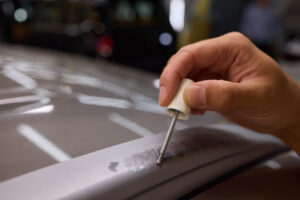
This is the most important thing to understand before attempting any scratch removal, and it’s the piece most DIY advice skips entirely.
Your vehicle’s exterior is made up of several distinct layers:
- Clear coat — the outermost transparent protective layer
- Base coat — the color layer that gives your car its paint color
- Primer — a preparatory layer that helps paint bond to the metal
- Metal (or plastic) — the substrate underneath everything
Where a scratch sits within these layers determines what can be done about it — and by whom.
Clear Coat Scratches These are the most common type and the most fixable. Clear coat scratches don’t penetrate through to the color layer. In bright sunlight or under a detail light, they appear as fine lines, swirl patterns, or hazy scuffing on the surface. Run your fingernail lightly across the scratch — if your nail glides over it without catching, it’s almost certainly a clear coat scratch. These are fully addressable through professional polishing.
Base Coat Scratches These penetrate through the clear coat into the color layer. They typically appear as a white or lighter-colored line within the scratch, because the clear coat above the base coat has been removed and the underlying color is exposed or disrupted. Fingernail test: your nail will catch in the groove. These require more than polishing alone and may need touch-up paint as part of the repair.
Primer and Deep Scratches These penetrate all the way through the color coat to the primer or bare metal. They’re often wider, more jagged, and show gray, white, or bare metal at the deepest point. These require paintwork — touch-up paint at minimum, and in severe cases, professional bodywork and respray. They are outside the scope of detailing alone.
Before pursuing any scratch removal solution, properly identifying the depth of the scratch saves time, money, and the risk of making things worse.
What Actually Works
Professional Machine Polishing — For Clear Coat Scratches For scratches that live within the clear coat, machine polishing is the most effective solution available. Using a dual-action or rotary polisher with the appropriate compound and pad, a professional detailer carefully abrades the surrounding clear coat down to the level of the scratch, effectively leveling the surface and eliminating the scratch from view.
This is the same process used in paint correction, and it’s genuinely effective on clear coat damage. Results range from complete elimination of the scratch to a significant reduction in visibility, depending on the depth and character of the scratch. A professional will assess each scratch honestly and tell you what level of improvement is achievable before beginning work.
The key word here is professional. Machine polishing done incorrectly — too aggressive a compound, too much heat, or too many passes — can thin the clear coat dangerously or create new damage. The right equipment and experience matter.
Touch-Up Paint — For Base Coat Scratches When a scratch has broken through to the base coat, polishing alone won’t solve it. The missing color needs to be replaced before the surface can be leveled and finished. Touch-up paint matched precisely to your vehicle’s paint code can fill the scratch, which is then carefully leveled and polished to blend with the surrounding paint.
This process requires patience and skill. Paint codes can be found on a sticker inside the driver’s door jamb. The application, drying, and leveling process done properly can produce a result that’s nearly invisible. Done carelessly, it can look worse than the original scratch.
Wet Sanding — For Specific Surface Scratches In some cases, particularly with deeper clear coat scratches or paint transfer from another vehicle, wet sanding with very fine grit sandpaper before machine polishing can achieve results that polishing alone cannot. This is an advanced technique that removes more material than standard polishing and requires an experienced hand. It’s not appropriate for every situation, but it expands the range of scratches that can be addressed without bodywork.
What Doesn’t Work
Let’s be direct about some of the scratch removal myths that circulate online.
Toothpaste Toothpaste is mildly abrasive, which is why it occasionally appears to reduce the visibility of very fine surface marks. In reality, it’s far too inconsistent and imprecise for reliable scratch removal. It may temporarily fill a scratch with residue that makes it less visible until the next wash, but it doesn’t remove the scratch. It also introduces new fine scratches from its abrasive particles if used on a surface that isn’t thoroughly clean.
Scratch Removal Pens and Wax Sticks These products work by filling a scratch with a colored or clear waxy compound. For very fine scratches, they can temporarily reduce visibility. But the fill wears away, they don’t address the underlying surface damage, and color-matching is rarely accurate enough to be invisible. They’re a cosmetic band-aid, not a repair.
DIY Rubbing Compound Without a Machine Hand-applying rubbing compound to a scratch almost never produces a good result. Without a machine to control speed, pressure, and heat, it’s nearly impossible to level the surface uniformly. You’re more likely to create haze, buffer swirls, and uneven finish than to improve the scratch. The polishing process requires mechanical precision that hand work simply can’t replicate.
“Scratch Remover” Spray Products Most of these products are glorified waxes or polish liquids that temporarily fill and mask very minor surface scuffs. On anything deeper than the shallowest surface marks, they will not produce meaningful results.
When Detailing Can’t Fix It
It’s worth being straightforward about the limits of scratch removal through detailing. If a scratch has broken through to primer or bare metal, polishing and touch-up paint can improve its appearance but cannot fully restore the surface to factory condition. In these cases, the right answer is professional bodywork — either spot repair or panel respray depending on the severity.
A reputable detailer will tell you this clearly rather than taking your money for a service that can’t deliver the result you’re expecting. Part of what makes professional detailing valuable is the honest assessment that happens before any work begins.
There are also scratches that technically fall within the range of what detailing can address, but where the clear coat is already so thin — from age, prior polishing, or the depth of the scratch — that removing more material to level the scratch isn’t safe or advisable. A paint depth gauge measurement will reveal whether there’s enough clear coat left to work with.
Protecting Against Future Scratches
Once scratches have been addressed, protection matters. There are two primary products worth knowing about:
Ceramic Coating A ceramic coating adds hardness to the surface of the clear coat, providing meaningful resistance against fine scratches and swirl marks from everyday contact. It won’t prevent a sharp object from scratching through, but it significantly reduces the accumulation of light surface damage over time — particularly the kind caused by improper washing and incidental contact.
Paint Protection Film (PPF) For protection against physical impact — rock chips, scratches from road debris, door dings — paint protection film is the gold standard. PPF is a thick, flexible urethane film applied to high-impact areas of the vehicle. Many premium PPF products are self-healing, meaning light scratches in the film surface disappear with heat exposure. PPF and ceramic coating are often applied together, with PPF on high-impact zones and ceramic coating over the entire vehicle.
Getting an Honest Assessment
If your vehicle has scratches you want addressed, the most important first step is getting an accurate assessment of what those scratches are and what can realistically be done about them. Not every scratch needs professional bodywork, and not every scratch can be solved with a polish — knowing which category you’re dealing with saves frustration and money.
At Massachusetts Mobile Detailing, we assess scratch damage honestly before recommending any service. We serve customers throughout Massachusetts, coming directly to your location with professional equipment and a process built around real results. If the scratch is within the range of what detailing can address, we’ll tell you exactly what to expect. If it isn’t, we’ll tell you that too.