
There is a vehicle maintenance issue that millions of drivers overlook entirely — not because it’s hidden or complicated, but because it happens so gradually that most people simply stop noticing it. Cloudy, yellowed, oxidized headlights are one of the most common cosmetic problems on vehicles more than a few years old, and they are also one of the most genuinely dangerous.
This isn’t a purely aesthetic issue. Degraded headlights don’t just look bad. They perform badly — and on a dark Massachusetts highway in November, that performance gap has real consequences.
Headlight restoration is one of the most cost-effective services in professional detailing, delivering dramatic improvements in both appearance and safety. Here’s everything you need to know.
Why Headlights Go Yellow and Cloudy
Modern vehicle headlight lenses are made from polycarbonate plastic rather than the glass used in older vehicles. Polycarbonate is lighter, more impact-resistant, and easier to shape into the aerodynamic forms of modern headlight assemblies. But it has one significant vulnerability: UV sensitivity.
From the day a vehicle leaves the factory, UV radiation from the sun begins breaking down the outer surface of the polycarbonate lens. Manufacturers apply a UV-protective coating to the lens surface during production, but that coating degrades over time — typically within three to five years of regular outdoor exposure. Once the protective coating is gone, the UV degradation of the polycarbonate itself accelerates rapidly.
The result is oxidation — a yellowing, clouding, and haziness that develops on the lens surface and, in more advanced cases, penetrates into the lens material itself. In addition to UV damage, headlight lenses accumulate surface scratches from road debris, pitting from sand and grit, and chemical contamination from road spray and environmental fallout. All of these factors compound to produce the foggy, dull lenses that are a familiar sight on vehicles five years old and beyond.
Massachusetts conditions are particularly hard on headlight lenses. The combination of strong summer UV, road salt and chemical spray in winter, and the general environmental demands of New England driving accelerates the degradation process compared to vehicles in more temperate climates.
The Safety Consequences of Cloudy Headlights
This is where headlight degradation moves from a cosmetic concern to a genuine safety issue, and it’s worth being direct about the numbers.
Studies on headlight performance have found that oxidized headlights can transmit as little as 20 percent of the light output of clear lenses. That’s not a minor reduction — it’s a catastrophic loss of illumination. A vehicle that originally produced adequate road lighting at night is now operating with a fraction of its designed light output, dramatically reducing the driver’s ability to see road hazards, pedestrians, animals, and other vehicles at distance.
The practical effect: stopping distances that assume adequate visibility become dangerously optimistic. Reaction time to hazards depends on seeing them — and cloudy headlights reduce the distance at which hazards become visible. On rural Massachusetts roads at night, where deer crossings are common and road lighting is minimal, this is a meaningful safety consideration.
There is also the question of how other drivers and pedestrians see your vehicle. Clear headlights project light forward in a defined, intentional beam pattern. Oxidized lenses scatter and diffuse that light, reducing both forward projection and the visibility of your vehicle to others.
Beyond performance, Massachusetts vehicle inspections include headlight checks. Severely degraded headlights can result in a failed inspection, which means no registration renewal until the issue is addressed.
What Headlight Restoration Involves
Professional headlight restoration is a multi-step process that removes the oxidized and damaged outer layer of the lens, restores optical clarity, and applies protection to slow future degradation.
Step 1 — Surface Assessment Not all headlight degradation is the same. Oxidation that is primarily surface-level — the typical yellowing and cloudiness — responds very well to restoration. Oxidation that has penetrated deeply into the lens material, or lenses with internal fogging from moisture intrusion inside the housing, present more complex situations. A professional assessment identifies what is present and what level of improvement is achievable.
Step 2 — Masking Before any abrasive work begins, the surrounding paint and trim must be carefully masked. The restoration process involves sanding and compounds that would damage paint if contact occurred. Thorough masking protects the surrounding panels throughout the process.
Step 3 — Wet Sanding The restoration process begins with wet sanding using progressively finer grit sandpaper. This stage removes the oxidized outer surface of the lens — the yellowed, pitted, and scratched material — working down through grades from coarser to finer until the lens surface is uniformly smooth. At this stage, the lens will appear uniformly hazy rather than clear, but the oxidized material has been removed.
Step 4 — Compounding and Polishing Machine compounding and polishing follows the sanding stages, using progressively finer abrasives to refine the lens surface from hazy to clear. This is the stage where the dramatic transformation occurs — the lens goes from opaque and yellowed to genuinely transparent as the surface is brought to a high optical clarity.
Step 5 — UV Sealant Application This step is the one most often skipped in quick, low-quality restoration jobs — and its omission is why many headlight restorations look great initially and return to a degraded state within months.
The reason the headlights degraded in the first place is UV exposure destroying the factory protective coating. Restoring the lens without replacing that UV protection simply exposes the fresh polycarbonate surface to the same UV radiation that caused the original damage. Without a UV sealant, restored headlights will begin yellowing again within three to six months.
A quality professional restoration applies a dedicated UV-resistant sealant or coating to the restored lens surface, protecting the polycarbonate from UV degradation and significantly extending the longevity of the restoration. Some professional detailers apply a ceramic coating to the lens surface for even longer-lasting protection.
How Much Improvement Can You Expect?
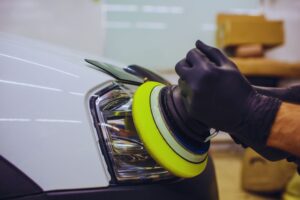
For lenses with surface oxidation — the typical yellowing and cloudiness found on most vehicles in the five to fifteen year age range — professional restoration delivers dramatic results. Lenses that were visibly yellow and opaque become clear, and light output is restored to levels close to the original specification.
The degree of improvement depends on the severity and depth of the oxidation. Surface oxidation responds completely to restoration. Oxidation that has penetrated deeper into the lens material can be significantly reduced but may not be fully eliminated. Internal fogging from moisture inside the housing is not addressable through lens restoration — it requires housing replacement.
A professional will assess the lenses before beginning and give you an honest expectation of the result. In the vast majority of cases, the improvement is substantial and immediately visible.
How Long Does Headlight Restoration Last?
With proper UV protection applied after restoration, professional headlight restoration typically lasts one to three years before noticeable re-yellowing occurs. The variance depends on how much UV exposure the vehicle sees, where it’s stored, and the quality of the sealant applied.
Vehicles parked outdoors year-round in full sun will see faster re-degradation than garaged vehicles. Applying a ceramic coating over the restored lens rather than a basic sealant extends longevity significantly.
Periodic maintenance — cleaning the lenses carefully and avoiding harsh chemical cleaners that degrade the sealant — helps preserve the restoration longer. Some vehicle owners incorporate a headlight inspection and touch-up into their annual detailing schedule to keep the lenses in consistently good condition.
Restoration vs. Replacement
The alternative to restoration is headlight assembly replacement — purchasing new OEM or aftermarket headlight housings and installing them. For lenses with internal damage, moisture intrusion, or physical cracking, replacement may be the correct solution.
For the vast majority of vehicles with typical oxidation damage, however, professional restoration delivers results comparable to new lenses at a fraction of the cost. New OEM headlight assemblies for many vehicles run into hundreds of dollars per side before installation labor. Professional restoration achieves optically clear lenses and restored light output for significantly less.
The cost calculus is straightforward: restoration first, replacement only when restoration cannot achieve an adequate result.
The Overlooked Detail That Changes Everything
Headlight restoration tends to get overlooked because it doesn’t fit neatly into the category of either cosmetic detailing or mechanical maintenance. It lives in between — a detail service with genuine safety implications.
For Massachusetts drivers, the combination of UV exposure, harsh winters, and the vehicle inspection requirement makes it a service worth taking seriously. A vehicle with restored, clear headlights is safer to drive at night, more likely to pass inspection, and noticeably better looking than one with the yellowed, foggy lenses that become so common as vehicles age.
At Massachusetts Mobile Detailing, we provide professional headlight restoration throughout Massachusetts, coming directly to your location. If your headlights have developed the yellowing and cloudiness that comes with age and UV exposure, restoration is one of the most impactful and cost-effective services available — and we bring the full professional process directly to your driveway.