
There is a reason paint protection film has become one of the most sought-after services among vehicle owners who are serious about preserving their investment. It offers a level of physical protection that no wax, sealant, or ceramic coating can match — because it operates on an entirely different principle. Where coatings protect the surface chemically, paint protection film protects it physically.
If you’ve ever watched a rock chip appear on a freshly detailed hood, or found a deep scratch from road debris on a panel you take pride in keeping flawless, paint protection film is the answer to that problem.
This guide explains exactly what PPF is, how it works, where it makes sense to apply it, and how it compares to and combines with other paint protection options.
What Is Paint Protection Film?
Paint protection film — commonly referred to as PPF, clear bra, or urethane film — is a thick, transparent thermoplastic urethane film applied directly to the painted surfaces of a vehicle. It was originally developed for military use, designed to protect helicopter rotor blades and vehicle surfaces from debris damage in harsh conditions. The automotive industry adopted the technology, and modern PPF has evolved significantly from those early applications into a refined, optically clear product designed specifically for vehicle paint protection.
Unlike window tint, which is applied to glass, PPF is applied to painted body panels. Unlike ceramic coating, which bonds chemically to the clear coat at a molecular level, PPF sits on top of the paint as a physical barrier — absorbing impacts, deflecting debris, and taking damage that would otherwise reach your paint.
Modern PPF is virtually invisible when properly installed. On a quality film applied by an experienced installer, you won’t see the edges, won’t notice the film in normal viewing conditions, and won’t detect any change in the appearance of the paint beneath it. What you will notice is that the paint stays looking the way it did the day the film went on.
How Paint Protection Film Works
The protective mechanism of PPF is straightforward: it interposes a durable, flexible layer of urethane between your paint and whatever the road throws at it.
Impact Absorption Rock chips are the most common form of paint damage on the front of any vehicle. At highway speeds, small stones and road debris strike the hood, bumper, fenders, and mirrors with enough force to chip through clear coat and base coat in an instant. PPF absorbs that impact energy. The film takes the chip instead of the paint. Depending on the severity, the film may show a small mark — but that mark can often be addressed without affecting the paint beneath.
Self-Healing Technology One of the most significant advances in modern PPF is self-healing capability. The top coat layer of quality PPF contains elastomeric polymers that have memory — when the film surface is scratched or scuffed by light contact, heat activates the self-healing process and the surface returns to its original smooth state. Warm weather accelerates this naturally; a heat gun or warm water speeds the process for deeper surface marks. This means light scratches in the film surface don’t accumulate the way they would on unprotected paint.
UV Protection PPF blocks UV radiation, protecting the paint beneath from the oxidation and color fading caused by prolonged sun exposure. This is particularly relevant for vehicles that spend significant time parked outdoors.
Chemical Resistance Like ceramic coating, PPF provides resistance against acidic contaminants — bird droppings, tree sap, road salt, and industrial fallout. The film surface is chemically resistant, reducing the etching damage these substances can cause when they sit on the surface.
Flexibility and Conformability Modern PPF is highly flexible and conforms to the complex curves and contours of vehicle body panels without creasing, lifting, or distorting. High-quality film stretches around edges and into recesses, providing complete coverage without visible lifting at the edges.
Where PPF Is Applied
PPF can be applied to the entire vehicle or to specific high-impact zones. The right approach depends on the owner’s priorities and budget.
Full Front End Coverage The most popular partial application covers the front bumper, full hood, front fenders, side mirrors, and A-pillars. This targets the areas that take the most abuse from road debris at speed — the zones where rock chips and impact damage most commonly occur. For daily drivers on Massachusetts highways, full front end coverage is where PPF delivers the highest return on investment.
Partial Hood and Bumper A more targeted option covers the leading edge of the hood — typically 18 to 24 inches back from the front — and the front bumper. This addresses the highest-impact zone at a lower cost than full front coverage. It’s a practical choice for owners who want meaningful protection without full front end commitment.
Full Vehicle Wrap A full PPF wrap covers every painted panel of the vehicle — hood, fenders, doors, rocker panels, rear bumper, trunk, and roof. This is the maximum protection option, typically chosen for high-value vehicles, new vehicles the owner wants to keep in pristine condition for years, or vehicles that will be driven in particularly demanding conditions. A full wrap combined with a ceramic coating over the top provides the most comprehensive paint protection available.
High-Impact Specific Areas Beyond the front end, certain areas are particularly vulnerable depending on driving habits and vehicle type. Rocker panels take damage from road debris kicked up by tires. Door edges and door cup areas accumulate scratches from everyday use. Rear bumpers suffer scuffing from loading and unloading. Targeted PPF application to these specific zones addresses the damage patterns most relevant to how a vehicle is actually used.
PPF vs. Ceramic Coating: Understanding the Difference
This comparison comes up frequently, and the answer is that these are complementary products, not competing ones.
What PPF Does That Ceramic Coating Cannot PPF provides physical impact protection. Ceramic coating does not. No ceramic coating — regardless of hardness rating — will prevent a rock chip. The coating is measured in microns; a rock chip penetrates millimeters. For protection against physical damage from road debris, PPF is the only product that works.
What Ceramic Coating Does That PPF Alone Cannot Ceramic coating provides an exceptionally hydrophobic surface, chemical resistance across the entire vehicle, and ease of maintenance that PPF alone doesn’t deliver to the same degree. A ceramic coating over PPF gives the film a slick, easy-to-clean surface and enhances the gloss of the film itself.
The Combined Approach The professional standard for maximum paint protection is PPF on high-impact areas combined with ceramic coating over the entire vehicle — including over the PPF. This gives you physical impact protection where it matters most, chemical and UV protection across the full surface, and the hydrophobic and gloss benefits of ceramic coating everywhere. It’s the approach chosen for vehicles where paint preservation is a genuine priority.
The PPF Installation Process
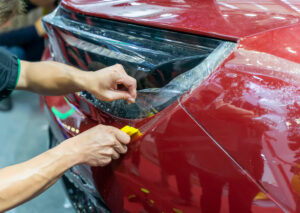
Quality PPF installation is a precision craft. The film must be cut exactly to the geometry of each panel, applied without contamination, and finished without visible edges or lifting. The difference between a professional installation and a poor one is immediately apparent — and a poor installation is expensive and difficult to correct.
Pattern Cutting Modern PPF installers use computer-generated cutting patterns specific to each vehicle make, model, and year. These patterns are plotted to precise dimensions and cut with a plotter, ensuring the film covers the intended area completely with clean, accurate edges. Custom cutting — trimming film directly on the vehicle — is an older technique that carries more risk of accidental paint damage from the cutting blade.
Surface Preparation Before any film goes on, the paint surface must be completely clean and decontaminated. Any dirt, wax, or contamination trapped beneath the film will be visible and will compromise adhesion. Paint correction is recommended before PPF application on vehicles with existing paint defects, for the same reason it precedes ceramic coating — the film is transparent, and whatever is beneath it stays beneath it.
Application Film is applied using a slip solution that allows positioning before the film sets. Once positioned correctly, the solution is squeegeed out from beneath the film, and the adhesive bonds to the paint surface. Edges are carefully worked to ensure full adhesion without lifting. This process requires patience, controlled conditions, and experience with how the specific film behaves.
Cure Time Newly applied PPF requires time to fully cure and bond. During the initial cure period — typically 48 to 72 hours — the vehicle should be kept dry and out of extreme conditions. Some cloudiness or water bubbles beneath the film are normal immediately after installation and resolve as the film cures.
How Long Does PPF Last?
Quality paint protection film from reputable manufacturers carries warranties of 10 years against yellowing, cracking, peeling, and delamination. Real-world longevity for properly installed, well-maintained film regularly meets or exceeds that window.
Film longevity is affected by maintenance practices, environmental exposure, and the quality of the original installation. PPF should be washed carefully — avoiding high-pressure water directly at film edges — and should not be subjected to automatic brush car washes, which can lift edges over time. A ceramic coating over the PPF simplifies maintenance and helps preserve the film surface.
When PPF does eventually reach the end of its life, it can be removed without damaging the paint beneath — one of the significant advantages of film over paint modifications. The paint under properly installed and maintained PPF often looks better than surrounding unprotected panels, having been shielded from years of UV and environmental exposure.
Is PPF Worth It in Massachusetts?
For Massachusetts drivers, the case for paint protection film is particularly strong.
Highway driving on roads with significant truck traffic means consistent exposure to road debris at speed. Winter road treatment — sand, salt, and gravel — creates some of the most abrasive conditions a vehicle’s front end will face anywhere. Spring brings the aftermath of that treatment, with loose material on road surfaces until cleanup catches up. Summer highway driving at speed means rocks. Year-round, Massachusetts roads are hard on vehicle paint.
Front end PPF on a vehicle driven regularly on Massachusetts highways is one of the most practical investments a vehicle owner can make. The cost of a quality front end application is a fraction of the cost of repainting a hood or bumper — and a repaint, however well done, is never quite the same as factory paint.
Protecting Your Investment from Day One
The ideal time to apply paint protection film is when a vehicle is new, before it has accumulated any chips or scratches. Fresh factory paint with no defects goes under the film and stays that way. For vehicles that already have some road wear, paint correction before film application addresses existing defects before they’re locked under the protective layer.
At Massachusetts Mobile Detailing, we provide paint protection film installation throughout Massachusetts, coming directly to your location with professional equipment and precision-cut patterns for your specific vehicle. Whether you’re looking for targeted front end protection or a full vehicle wrap, we assess your vehicle honestly and recommend the coverage that makes the most sense for how you drive and what you want to protect.